

Collaborative robots have changed the perception of industrial automation, particularly among smaller and medium-sized manufacturers. Instead of designing a large robotic cell around one high-volume process, companies can use more compact systems for tasks that change more frequently. The attraction is not simply that cobots can work in environments shared with people, but that many collaborative systems are designed around easier deployment and reconfiguration.
That flexibility should not be exaggerated. Cobots still need appropriate tooling, fixtures, programming and safety measures, and not every production process benefits from a collaborative approach.
The application matters more than the label
The term “cobot” is sometimes interpreted as meaning that a robot can always operate beside an employee without physical guarding. In reality, the safety of a robotic application depends on the complete system, including the tool, workpiece, speed, force and hazards created by the process. A collaborative robot handling a sharp component or operating a potentially dangerous tool may still require additional protective measures.
The practical advantage of collaborative automation is therefore better understood in terms of accessibility and flexibility. Many systems are intended to make setup and redeployment more manageable, which can be useful in factories where production runs are too short to justify highly dedicated automation.
Tooling determines what the robot can actually do
A robot arm provides movement, but the end effector determines how it interacts with the product. This is why the development of Onrobot cobotics and similar tooling ecosystems has become important to the broader collaborative automation market. The current OnRobot range, for example, spans two-finger, vacuum and magnetic gripping as well as sensing, screwdriving and finishing tools.
Different processes naturally require different solutions. A parallel gripper may work well for machined components, while packaging might be better suited to vacuum gripping. Irregular or delicate products can require compliant contact surfaces, and assembly may benefit from controlled screwdriving or force sensing.
The correct tool is therefore usually selected from the process backwards. Starting with the workpiece, rather than the robot catalogue, reduces the risk of creating a cell that is technically impressive but difficult to use in production.
Machine tending is a strong example
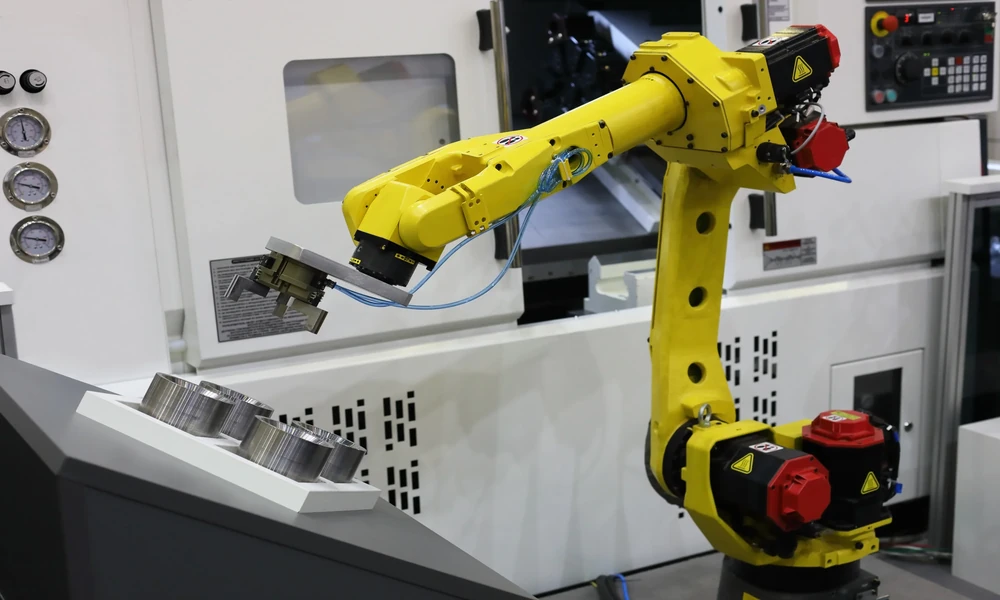
CNC machine tending is often a good fit for collaborative automation because the task has a clear repetitive structure. A blank is loaded, machining takes place, and the finished component is removed. Where parts can be presented reliably, a robot can take over much of this repetitive handling while the operator focuses on inspection, setup or other machines.
The economic value does not always come from replacing a complete job. In many workshops, the more realistic benefit is increasing the amount of productive work one employee can supervise. That distinction matters because automation projects based solely on theoretical labour elimination can easily overstate their financial return.
Packaging and assembly need different kinds of flexibility
Packaging usually involves relatively simple movements, but product dimensions and box formats may change frequently. An adaptable gripping system can therefore matter more than maximum robot speed. Assembly presents another challenge because component positioning, tool access and process verification become more important.
Screwdriving is a good example. The robot may reach every fastening point perfectly, yet the process can still fail if screws are presented inconsistently or the joint requires tighter process control. Collaborative automation works best when these practical details are considered during design rather than treated as issues to solve after installation.
Cobots do not remove process engineering
One of the risks surrounding collaborative robotics is the assumption that easier programming makes the whole automation project simple. A robot may indeed be quicker to configure than traditional equipment, but poorly organised production does not become efficient merely because a cobot has been added to it.
Parts still need to arrive in predictable positions. Fixtures must locate them accurately, cycle time has to meet production demand, and operators need a clear method for dealing with exceptions. The process should therefore be stabilised before automation wherever possible.
Collaborative automation is most useful in the space between fully manual work and highly dedicated machinery. Repetitive tasks that also contain a manageable amount of variation are often the strongest candidates. In those situations, flexibility has real value because the robot can support production without requiring the factory to behave like a fixed mass-production line.
